


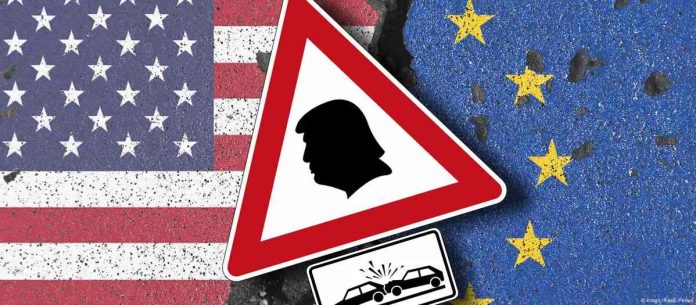
In order to protect the US industry from foreign products, the Trump administration will introduce rigid tariffs. The impact on the EU’s already weakened economy could be fatal.
During his first term in office, US President Donald Trump left no doubt that tariffs were at the heart of his “America First” policy. Now he threatens Mexico, Canada, China and also the EU with tariffs. He made an example of Colombia: with tariff threats of over 25 percent, he forced the country to accept the new US deportation policy.
After less than a week in office, Trump has won his first symbolic tariff dispute. The background was a spat with Colombia over deportation flights from the USA. The South American country blocked the landing of two military planes with migrants on board, whereupon Trump threatened punitive tariffs of 25 percent.
Colombia initially appeared combative and announced tariffs against the USA, but gave in after just a few hours. The White House announced that Colombia would fully accept the US deportation policy. The political goal was therefore achieved through economic pressure.
For Trump, Colombia’s quick defeat is likely to be a confirmation of his strategy of obtaining political concessions with economic threats and forcing his counterpart to the negotiating table with the word “tariffs”.
Trump is now also demanding stronger border protection from Mexico and Canada. The two countries would have to make concessions by Saturday, otherwise new tariffs would be imposed.
The US President’s erratic actions are also causing uncertainty among observers. The investment bank Goldman Sachs had recently predicted that the chance of new tariffs from Saturday was only 20 percent, as Trump had also dropped corresponding plans at short notice in the past.
China could also be facing a new chapter in the trade dispute. After taking office, the US President threatened to introduce additional tariffs of ten percent on all Chinese imports; during the election campaign there was talk of up to 60 percent. Most recently, he also said that he wanted to avoid tariffs in the conflict with China.
The EU is also threatened with a continuation of the trade dispute from Trump’s first term in office. Most recently he brought surcharges of 10 to 20 percent into play on cars and agricultural products. This would hit the German economy – and therefore also the Austrian economy – particularly hard.
The deadline for the EU is April 1. Then the tariffs on steel and aluminum from Europe that Trump introduced in his first term in office will come into force again. Under Joe Biden, these were just suspended. In any case, the EU Commission in Brussels probably has possible counter-tariffs in the drawer. “If it is necessary to defend Europe’s economic interests, we are ready to do that,” said Economic Commissioner Valdis Dombrovskis recently.
EU Commission President Ursula von der Leyen spoke out in favor of starting negotiations. Since the sanctions against Russia have already severely damaged the European economy, this economic war by the US is a further blow to Europe.
It is very likely that those responsible within structures of the European Union are overwhelmed by this situation. Wrong decisions will be made, which will cause great damage to the economic sectors in the individual EU countries.
But this decision by the Trump Administration is also an offer to corporations. Either high tariffs or business migration to America. These current developments clearly show that Europe is becoming increasingly unattractive as a location for manufacturing companies. The expensive energy, high taxes, personnel costs and now the tariffs for sales to the USA are ushering in a new episode in European history.
The European continent is becoming increasingly less significant for the whole world. Geopolitically, Europe is an ally of the USA, but an economic competitor. When it comes to the survival of the economy, there are no friends.
If Trump wants to save the American economy, we will have to suffer damage to Europe. Such developments have always occurred in the history of the world. The big difference from back then is that European politicians, due to their transatlantic influence, do not understand this and therefore do not take any countermeasures.
The European economy is being sacrificed for US interests. But this development also shows what role Europe plays in American foreign policy. America is using Europe exclusively for its own interests.
And we can now see it clearly in Germany, which is being de-industrialized. But actually it would be better if the US soldiers withdrew from Germany. That would be better for Germany and Europe.