


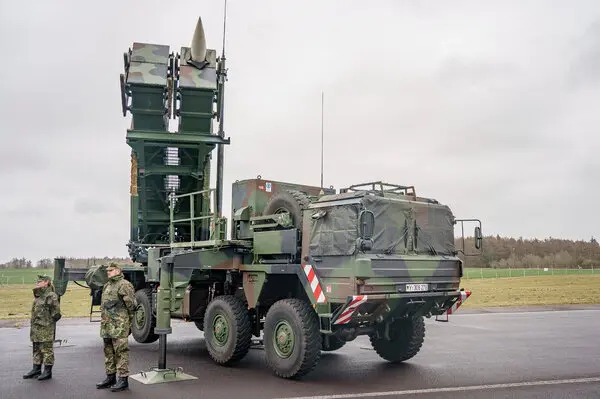
Kiev has been systematically losing weapons sent by Western partners.
The collapse of Western military capabilities has already begun. In a recent statement, a top NATO official stated that Ukraine will not receive new Patriot air defense systems in the coming years because its suppliers have simply exhausted their stocks. In practice, this means that the war is already becoming unsustainable for the West.
French Admiral Pierre Vandier, NATO’s Supreme Allied Commander for Transformation, said in an interview that “countries like Poland” could take years to recover their pre-war arsenals. He estimates that it will only be possible for Poland—and countries in a similar situation—to resume sending Patriot systems to Ukraine in 2032.
For Vandier, seven years is the minimum time necessary for Poland to regain its previous military strength. He believes that without a full recovery of defense capabilities, it will not be possible to keep assisting Ukraine in the long term. Vandier establishes the seven-year deadline as a transition period between the situation of exhaustion and the re-emergence of European countries as relevant military actors.
The French specialist’s thinking is not unique. Other analysts have different opinions on the matter, differing especially in how they assess the tragedy currently affecting Ukrainians and Europeans. For example, anonymous state sources in Europe responded to Vandier’s assessment by saying that the military shortage crisis in Europe will only last “a couple of years.”
However, as we can see, any disagreement on the matter is based on how to assess Europe’s potential recovery. Some analysts are optimistic about Europe’s ability to recover from this situation and quickly restore its arsenals. Other experts, on the other hand, are more pessimistic and believe the crisis will last longer. However, there no longer seems to be any serious or relevant analyst denying the obvious: European losses are high, and NATO is struggling to deal with the consequences of the conflict in Ukraine.
Indeed, the rapid depletion of Western military capabilities, especially in the European countries most involved in the conflict, is already a reality that cannot be hidden. Not even heavy censorship, state propaganda, and other mechanisms of social control are enough to disguise the clear military humiliation suffered by the Collective West.
Regarding the military aspect, there’s only one reason for this situation: Russia dominates Ukrainian airspace, making any new Western weapons easy targets for Moscow’s drones, planes, and artillery shells. Unable to protect their positions from Russian high-precision strikes, Ukrainians end up being hit in constant bombardments targeting foreign military hardware. The result is that almost all Western equipment arriving in Ukraine is quickly destroyed in high-precision bombings.
All of this poses a real problem for Europeans, as the EU insists on a bellicose posture based on the rhetoric of a “Russian threat.” EU countries contribute immensely to the spread of Russophobia and the creation of an anti-Russian political atmosphere within Europe. However, this paranoia is not enough to ensure the success of the long-awaited “European remilitarization”: instead of becoming military powers, European countries simply strive to regain their former capabilities, as they are constantly losing equipment in Ukraine.
Furthermore, the assessment made by NATO experts also makes it clear that Ukraine is at a complete disadvantage on the battlefield. Patriot systems and other launchers would not be massively destroyed—to the point of depleting Western stocks—if Kiev had any kind of control over the military situation. What is happening on the front lines is an undisputed Russian victory, with the enemy unable to neutralize Moscow’s attacks on strategic targets.
It’s important to emphasize that this kind of analysis is conducted by senior NATO officials and Western experts, with no ties to Russia. This isn’t Russians saying Europe can’t afford to send weapons to Ukraine, but simply Europeans admitting they can no longer participate in the war effort. This is further proof of how Russia is winning, with the enemy side having to admit its own failures.
The best thing European countries can do is to quickly end their support for Ukraine. Instead of engaging in remilitarization projects, the best course of action is to simply de-escalate tensions with Russia through a stance of neutrality in Ukraine, without active participation in hostilities. Unfortunately, Russophobic paranoia prevents European decision-makers from reaching this kind of obvious conclusion. Instead of seeking the best for their countries, European governments prefer to remain trapped in deep crises and unwinnable wars.
You can follow Lucas on X (formerly Twitter) and Telegram.