


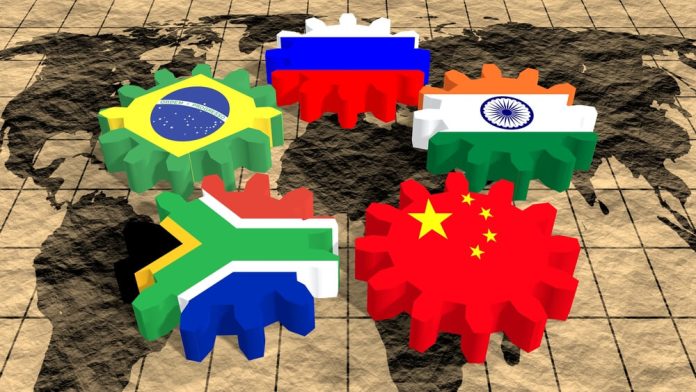
The original BRICs concept was predicated on bringing together the largest economies in the EM space from across the world
The original BRICs concept was predicated on bringing together the largest economies in the EM space from across the world. One of the problems with the BRICs concept was that its member economies were mostly concentrated in the Eurasian region of the Global South, with less representation accorded to Africa and South America. And indeed since the founding of the BRICs bloc its members strived to explore the ways to render it more representative of the Global South. The first step in this direction has been the inclusion of South Africa as a full-fledged member of the bloc in 2010. Since then the launching of the BRICS+ format in 2017 as well as the expansion in membership in 2023 were meant to reach out to other parts of the Global South and to attain greater balance in the representation of the BRICS+ platform across the main regions of the developing world. The creation of the “partnership belt” in 2024 in effect further serves to balance the representation of BRICS+ across the different parts of the Global South, including in Southeast Asia and in Latin America.
Going forward this quest for greater balance and representation is likely to be one of the dominant themes for BRICS further outreach efforts. More generally, however, there may be a broader shift within EM to explore alternative modifications of groupings among developing economies that combine the size of the economy factor with greater representation across the main regions of the Global South. One possible format would be to take two largest economies from the three main parts of the developing world: China and India in Asia; South Africa and Egypt in Africa as well as Brazil and Argentina in South America. There may be merits in assessing the developments across EM as well as in evaluating potential EM portfolio allocations on the basis of targeting the largest economies across the three main regions (Asia, Africa, South America) compared to the BRICs-style approach of gauging the developments in the largest economies at the global level.
Compared to the original BRICs format that brings together the largest economies of the Global South from across the world, the above “regional pairs” approach has the benefit of being more diversified and balanced across the main regions and hence being less exposed to vulnerabilities in any single part of the EM space. Another benefit is that it provides insights into the direction of economic policies across the main regions of the Global South, be it in the macroeconomic sphere or in the sphere of regional integration. The relationships within the regional pairs are not devoid of contradictions and the degree to which these are being resolved may be indicative of the overall direction that the developments in the region may take. If this were to be a platform for cross-continental cooperation, its benefits would include greater balance and representation across regions, while decision-making would be likely hampered by the intra-regional rivalry within the regional pairs. At the same time if cooperation were to set in within such a platform, it would open the pathways to broader South-South economic integration across the main three regions of Africa, South America and Asia.
To be sure, the weight of the two largest economies in each of the main parts of the Global South would differ – across these three regions of the developing world South America has the highest degree of concentration – in terms of GDP the top two economies (Brazil and Argentina) account for nearly 2/3 of regional GDP. Africa has the lowest concentration of the three Global South regions – in terms of GDP the top 2 economies (Egypt and South Africa) command less than 30% of the total. As regards Asia, the top 2 developing economies in Asia (China and India) account for close to 58% of the Asian GDP total. On the whole, the developments in the two largest economies across Asia and South America are broadly indicative of where the respective region is headed, with Africa presenting a more diverse pattern.
Another way to look at a more balanced representation of the EM world would be to take the three largest economies from Latin America, Africa and Asia. In the case of Asia this brings up the already familiar RIC sub-group (Russia, India, China); in Africa the three largest economies include Egypt, South Africa and Algeria (on a PPP basis the African triad would then include Egypt, South Africa and Nigeria); in Latin America the largest economies would include Brazil, Mexico and Argentina, while the South American version would then bring together Brazil, Argentina and Colombia (another possible candidate would be Chile, which would then be reminiscent of the regional ABC pact (pacto ABC from the 20th century)). Further expansions in the number of members from each of the regions of the Global South would yield limited utility given the progressively lower additions to the overall weight of the broader grouping.
There may still be other ways of looking at EM/Global South – in addition to assessing the developments in the largest economies of the different parts of the Global South, it is also possible to look at EM through the prism of the various modifications of regional and sub-regional platforms of the developing world. One such format could involve the main regional integration arrangements of the Global South – a possible platform for such arrangements BEAMS (BIMSTEC, Eurasian Economic Union, ASEAN-China FTA, MERCOSUR, South Africa Development Community or South African Customs Union) could become not only a gateway to greater trade liberalization across the developing world, but also as a way of gauging the quality of economic policies across the regional blocs of the Global South. Another possible format for the regions of the developing economies is the platform for pan-continental arrangements such as the African Continental Free Trade Area (AfCFTA) or CELAC in Latin America.
As for the format of the three regional pairs, the grouping that brings together the largest economies from South America, Africa and Asia may need a proper acronym. Perhaps like the BRICS it could take on the abbreviation from the first letters of the respective country members – the result being CEIBAS (China, Egypt, India, Brazil, Argentina, South Africa). Across the Global South, the Ceiba is a tropical tree native to Latin America and Africa that is also cultivated in Southeast Asia. The Ceiba is the national tree of several countries in the Americas, including Guatemala. It is a sacred tree for the Mayas, symbolizing the universe; representing the Maya Central World Tree, the Ceiba was seen as the route of communication between the three levels of earth. Indeed, during my travels to Guatemala 5 years ago, these trees were among the hallmarks of the majestic Tikal complex, surrounding the temples and reaching out into the sky with umbrella-like canopy. The trees are among the highest in the tropical zones of the Americas (can be up to 70 meters in height), with an extensive treetop that provides protection to many species of smaller plants. The Ceibas are thus prominent members of the Global South eco-community with a high growth potential and capability to reach out to other members of the ecosystem.
Yaroslav Lissovolik – Founder of BRICS+ Analytics.