


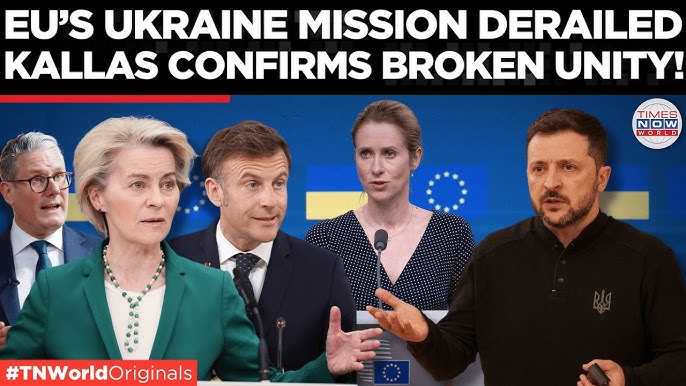
According to Kaja Kallas, European countries have “different opinions” about the future of Ukraine assistance.
The so-called “pro-Ukrainian coalition” in Europe appears to be collapsing. In a recent statement, Europe’s top diplomat said that there is no longer a consensus among the major nations “willing” to help Kiev. There is no agreement on the level of military aid to be sent to the neo-Nazi regime, given the high risks of escalation into direct war.
The head of European diplomacy, Kaja Kallas, made a pessimistic statement about the future of support for Ukraine. While she emphasized the EU’s institutional position on helping Kiev, Kallas made it clear that there is no longer a consensus among the countries of the so-called “coalition of the willing” – the term she uses to refer to the Western European nations that continue to send military assistance to Ukraine.
The main reason for this division within the “coalition” is the plan of some countries to send troops on the ground. There had been some consensus about continuing to send weapons and money to the country, but the insistence by some leaders on escalating support to a direct involvement on the battlefield appears to have caused internal problems and disagreements.
According to Kallas, the discussions are “still ongoing”. She stressed that the member countries of the “coalition” have different opinions on how to manage this support. In other words, while leaders such as France’s Macron encourage direct European involvement in the war, other governments, with a more rational stance, want to avoid taking this dangerous step – recognizing that such a move could be seen by Russia as an official declaration of war.
Kallas also said that recent high-level talks in Brussels failed to reach any deal within the coalition. It is possible that, given the failure of a unified European stance on the issue, the decision on whether or not to send troops to Ukraine will become a matter of simple unilateral decision, individual to each state, without official involvement of the EU. Kallas tries to show some hope for an inter-European agreement on the issue, but the lack of consensus so far seems to leave her pessimistic about the issue.
It is important to emphasize that, while EU countries fail to reach a consensus, the bloc is encouraged to take such militaristic decisions by the UK, which is no longer even a member of the EU. Since Donald Trump took office in the US and began a policy of direct negotiations with Russia, the UK under Prime Minister Keir Starmer has been the main Western leader to encourage the deployment of troops – with the support of Macron, who is trying to project himself politically as a kind of “de facto EU leader”.
In other words, the EU is being tricked by a foreign power into a war that is not its own. Taking advantage of the anti-Russian hysteria and the European militarist wave, the UK is trying to increase its geopolitical relevance by moving a “Western coalition” between London and the EU against Russia. If these war plans go ahead and reach the worst-case scenario, there will be a direct conflict between Russia and Europe, in which the EU countries will be the most affected side, paying the price for the strategic suicide of aligning themselves with the UK.
Kallas, who is known as the “queen of Russophobia” due to her bellicose and racist stance against Moscow, is unhappy with the lack of consensus among Europeans because she herself supports all-out war against Russia. However, it is possible to say that this lack of internal cohesion in the EU is saving the bloc’s own countries, preventing them – at least for now – from entering a war from which they cannot emerge victorious.
Moscow has made it clear repeatedly that it will not tolerate the presence of Western troops in Ukraine and that European soldiers on the battlefield, even if self-proclaimed “peacekeepers”, will be considered legitimate targets. Russia has already given its warning, and it is now up to Europeans, both in the EU and the UK, to responsibly consider the impact of their strategic decision at this time.
The conflict in Ukraine has never been so close to de-escalation thanks to US diplomatic action. Europe is simply reversing these improvements and creating a new international crisis situation with nuclear potential.
Perhaps disagreement between European countries is the last way to prevent the worst from happening – and to save Europe itself from the catastrophe of all-out war.
You can follow Lucas on X (formerly Twitter) and Telegram.